AI Avatar Product Concept
Two phases of mixed-methods research reframed an AI avatar concept from “smart speaker with a face” into a sharper expert-coach narrative with two viable beachhead audiences — directly shaping the product brief and supporting an executive demo.
Timeline: November 2025 — January 2026
My Role: Research Lead
Core Team: PM x 2 · Designer · Account Lead
Client: Fortune 100 Devices Team
Context
Our client had developed an exciting proof of concept that visualized AI into an avatar, gaining initial approval from SVP leadership to continue product development. While they recognized they had compelling technology, it lacked a sufficient marketing strategy.
Project Goal
Evaluate the viability of “AI Avatar” among a broad consumer set in order to define a GTM product strategy for executive leadership buy-in.
Core Questions
- Does this concept resonate with consumers?
- Who is the beachhead audience at product launch?
- How should the product be positioned?
- What is the role of the avatar for users?
Phase 1 (5 weeks)
Role
- Lead researcher
- Managed team of 1 quant researcher and 2 qual researchers
Summary
Mixed methods user research to evaluate high-level concept feedback, identify high-value segments, and interrogate an internal hypothesis that families with young children is the beachhead audience.
Concept Testing
Conducted concept testing across quant and qual methods via low-fidelity stimuli.
- “Sketches” conveying form factor and hardware features
- ~30 use cases write-ups

Quant Studies
- Captured psychographic and behavioral signals with high-level concept feedback to power segmentation
- Ensured minimum quota for families with young children
- Weighted results for region, HHI, and gender
- Identified 7 classes based based on 12 factors
- Primary differentiator was household composition and attitudes toward technology
Qual Studies
- Recruited power users of smart speakers, based on the hypothesis that "AI Avatar" is an evolution of the home smart speaker
- Balance of parents with young children and non-parent households
- Launched a diary study to get a sense of smart speaker ownership placement, rationale, and usage throughout home
- Multiple entries to understand various ways voice assistants help them throughout their day, including pain points
- Evaluated boundaries of technology: what they invite into the home, what they avoid, and why
- Establish key behaviors and probed on voice assistant usage
- Concept testing with feedback
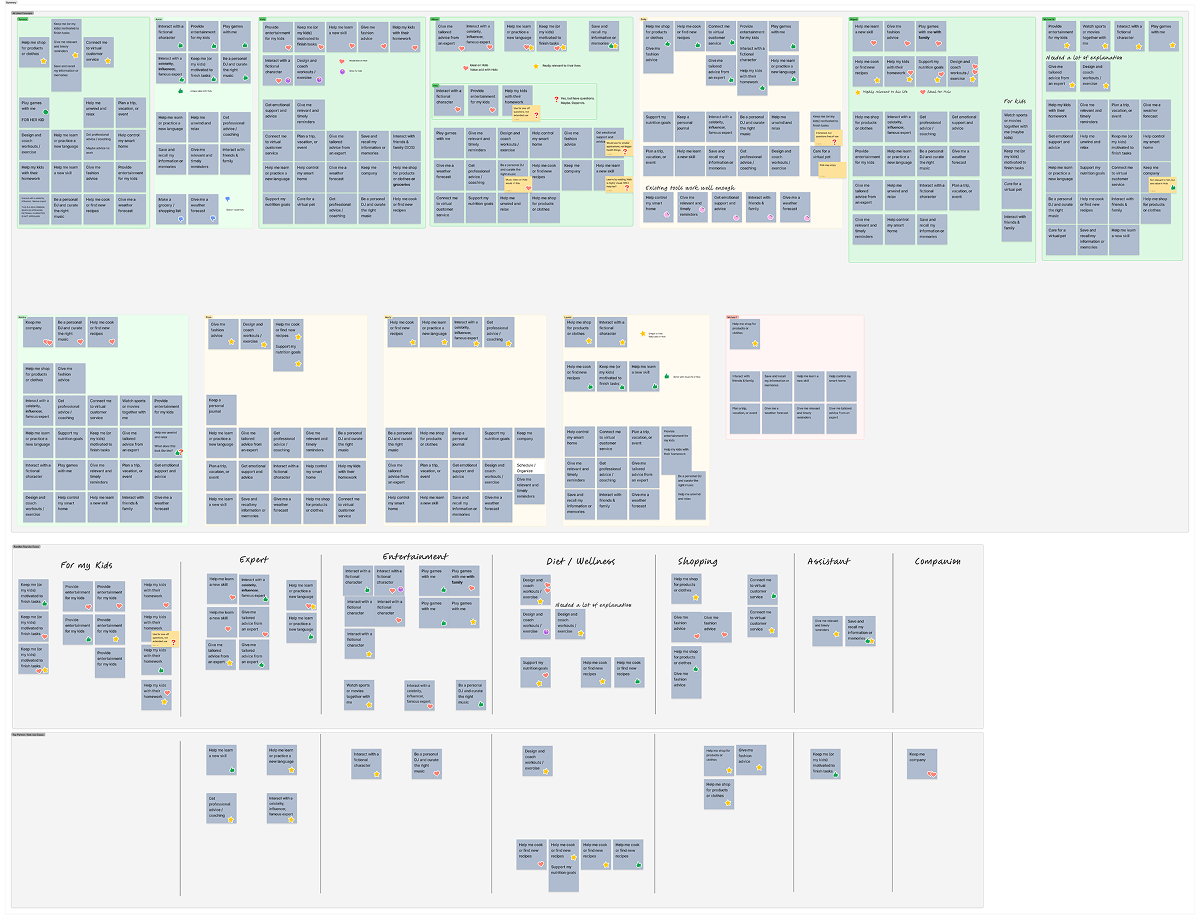
- Use case prioritization exercise with virtual whiteboard
Affinity Map Analysis
Phase 2 (4 weeks)
Objective
Two major shifts emerged from Phase 1
- Grounding Phase 1 in smart speaker power users was an intention choice that may have introduce bias into analysis. Phase 2 grounded in Gen AI chatbot usage of varying expertise
- Tested the avatar’s specific value relative to text chatbots and voice assistants, using refined stimuli and direct comparison tasks across additional IDIs.
- Use case testing with higher fidelity video clips
- 30-second intro
- 6 use case clips
- Voice / Screen / Avatar-based alt to isolate modality preference
Qualitative Methods
- TKTK
- TKTK

Key findings
- Validated that parents of young children are a beachhead family
- Identified a secondary beachhead audience with solo households that seek to continually self-improve with technology.
- Sharpened definition to families that encourage their kids to experiment with technology, particularly AI.
- Two "expert" use cases were the only scenarios where the avatar clearly outperformed voice-only interaction.
- "Assistant" use cases had immediate appeal, but middling value of the avatar.
- "Friend" use cases had niche appeal.
- Mismatched avatars (e.g., childlike voice paired with professional-advice use case) actively undermined user trust
- Repositioned avatar design from a styling decision to a functional product constraint.
- The need more a portable device came up unprompted in more than half of interviews.
- Informed the need for hardware requirement based on user demand, not assumption.
Reflections
Reversing my own methodological position mid-engagement — from quant-first to qual-first — was the right call and one I’d make again. The instinct to commit early was wrong; the concept’s maturity level should drive sequencing, not habit.
What I’d do differently:
-
Identify the single most load-bearing claim in the client’s internal narrative and test it directly in Phase 1. The client’s pitch leaned on an assertion that never made it into the stimuli — a gap that only became visible late. I’d also name client-side stakeholder misalignment earlier rather than absorbing it into the deliverable.
-
Synthesis framing matters as much as findings. A mid-engagement feedback session made clear the report read flat for internal selling — findings were right, but buried. Leading with the strategic assertion and using data to defend it, rather than building from data to assertion, is now a standing practice.