Expanding into the Bathroom
Led a 3-week discovery sprint that grounded the team in behavioral insights as we moved into a concepting sprint. The result was 5+ product concepts tied to specific user needs and behaviors.
Timeline: January 2026 — March 2026
My Role: User Researcher
Core Team: PM x 2 · Designers x 3 · Account Lead
Client: Fortune 100 Devices Team
Context
Our client is a well-known household brand, with market leadership for their flagship smart device product. Internal data showed consumers place these smart devices predominately in shared spaces (e.g., living rooms) and very low placement in private areas, such as the bathroom.
With fewer customers upgrading, our client wanted to explore purpose-built devices designed specifically for private spaces as a path for growing device ownership. Strategically, our PM team chose the bathroom to focus on, hypothesizing that it was a natural space for consumers to integrate health tech, a market that showed promising growth.
Project Goal
Develop a breadth of product concepts purpose-built for the bathroom, grounded in generative user research.
Core Questions
- How do people actually use bathrooms? What factors influence behavior?
- What does friction look like in real routines and bathroom spaces?
- How do personal devices and technology play a role in daily bathroom routines?
- What opportunities does health tech play in daily bathroom routines?
Sprint 1: Research (3 weeks)
Because this work was directly informing product concepting, we prioritized qualitative methods to gather anecdotes, rich insights.
Our imperative was to understand daily bathroom routines, the space, and existing device ownership, informing selection of a mobile diary study (dscout) as a field study.
Role
- Prioritized research questions with client
- Refined scope of PM’s research “wish list” of quant, qual, max/diff into high-value research for early concept stage work
- Designed, executed, and analyzed research
Methods
Recruitment: We recruited existing customers of smart device as a strategic imperative to target existing customers and grow device ownership.
There was a mix of household composition and bathroom sizes and we included a small subset of users with smart device already in the bathroom to understand behavior and pain points.
- Four structured activities covering smart device tours, bathroom tours, and morning/evening routine logging.
- Captured the realities of everyday bathroom spaces without observer effect.
- Primary goal: routine deep-dive based on diary entries via semi-structured interviewing
- Secondary goal: concept feedback on real CES 2026 products for an initial read on innovative bathroom technologies with structured interviewing
- Competitive landscape
- CES 2026 bathroom tech
- Syndicated behavioral data from the client's internal research team.
Analysis Process
- Gathered data using thematic analysis across 72 diary entries (18 participants x 4 activities) and 12 IDI transcripts using dscout
- Used thematic analysis to code data against our learning questions to ensure insights answered the team’s most important topics
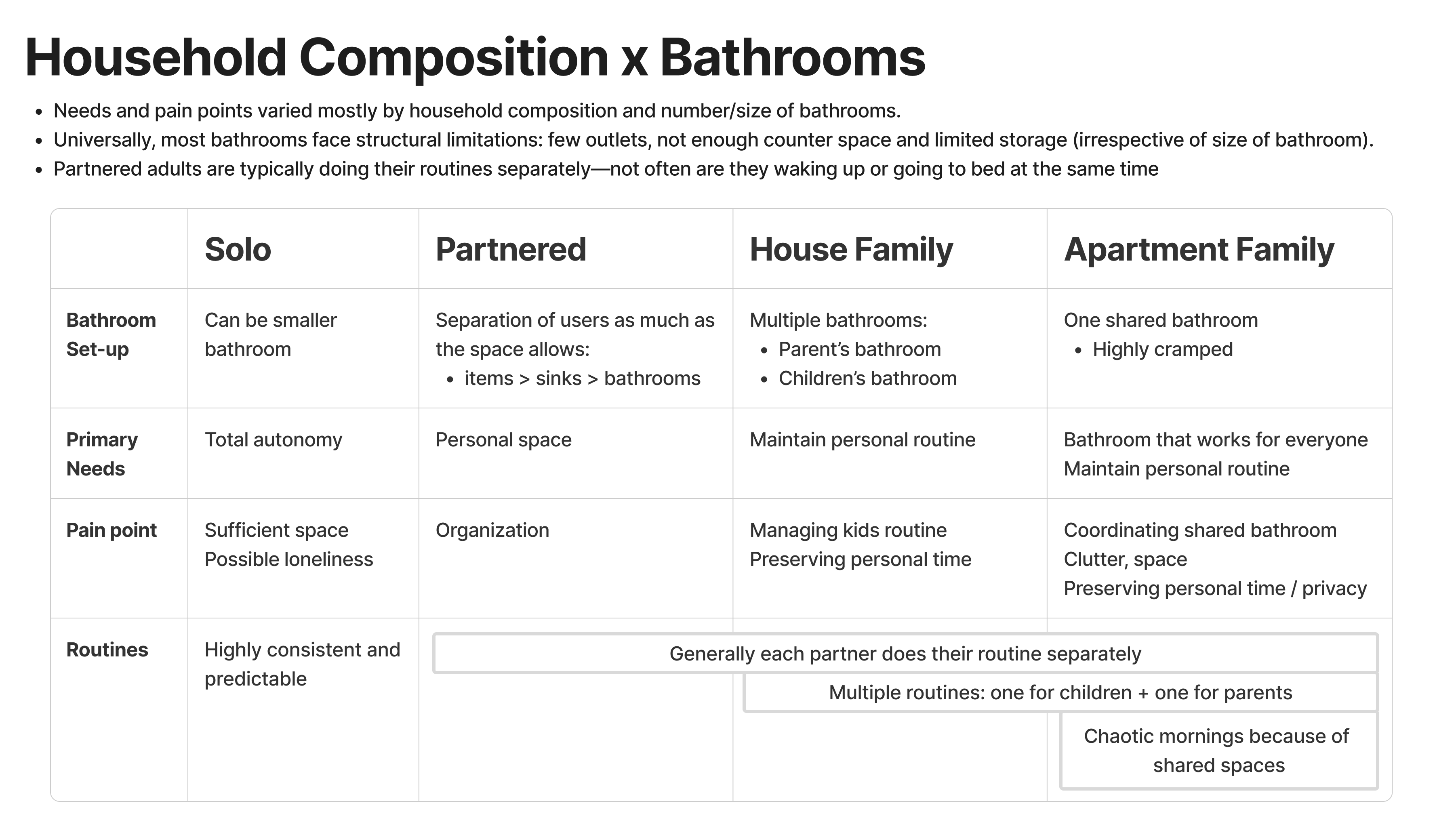
- Segmented responses by key variables (household composition, bathroom characteristics) to identify ubiquitous versus segment-specific behavior and mental models.
- Leveraged NotebookLM to pressure test themes against the full dataset and to systematically code participants against key variables to support claims
Key Findings
Sprint 2: Concepting (3 weeks)
Concept Ideation Workshop
- Led rapid insights presentation, grounding larger team in actionable information
- Partnered with Product Design team on workshop structure
- Facilitated break-out group
Concepting
- Generated breadth of concepts, with 2 ideas remaining in final 7 concepts
- Conducted ad hoc desk research to support market opportunity
Refinement
- Ensure concepts were grounded in insights
- Authored supporting section for each concept
Impact
This project was about early product concepting. The next phase of the process was an executive leadership presentation, which was positively received. Next steps are pending.
2. Maximizing hands-free productivity
3. On-demand health guidance
Reflections
Scoping hard at intake — negotiating health off the brief and right-sizing the research plan — was the decisive call that made delivery possible. The diary + IDI combination surfaced the efficiency/ritualism insight within the first days of fielding, giving synthesis a clear organizing frame.
What I’d do differently
Aligning Output Needs Earlier: The insights board went through a major rewrite two weeks before final delivery because the initial framing prioritized narrative over the statistical evidence the client needed for internal selling. Earlier alignment on what “a good research board” looked like for this context would have saved significant rework.